
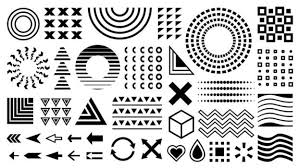
Geometry is not neutral. The shapes we build with, the angles we favour, and the symbols we use all carry energetic codes. They reflect how we organise the world — what we value, what we control, and how we create order. For millennia, human structures were dominated by straight lines, sharp corners, and rigid geometry — the architecture of masculine order.
But as with colour and sound, culture is shifting.
We are moving away from hard-edged certainty and into curves, arcs, and spirals — the rise of the feminine in shapes. This is not a sudden change, but a gradual rebalancing that is becoming more visible across the environments we build and the systems we design.
Masculine energy thrives on clarity, structure, and control. In form, this has long meant squares and rectangles that create boundaries and containment, alongside triangles and pyramids that reinforce hierarchy and direction. Right angles communicate certainty and precision, while straight lines suggest forward progression and control. These shapes have shaped not only our buildings, but also our systems of organisation and power.
They dominate institutions — office towers, flags, spreadsheets, and military insignia — where stability and predictability are essential. There is comfort in this geometry. It reduces ambiguity, creates clear edges, and defines roles and limits. But over time, these same qualities can become constraints, locking systems into rigidity and limiting their ability to adapt.
As a reaction to this rigidity, we have seen the rise of inverted and fragmented forms. Upside-down triangles subvert hierarchy, while asymmetry breaks away from predictable geometry. Fractals and glitch-inspired designs introduce jagged disruption, and postmodern architecture bends or distorts traditional structures. These expressions challenge order, questioning the dominance of rigid systems and introducing unpredictability.
Yet these forms are still defined by the systems they resist. They disrupt structure, but remain tied to it, reacting rather than transforming. The rules are bent or broken, but not fully transcended. In many ways, this phase reflects a cultural moment of tension — a push against control without yet establishing a new, coherent form.
In contrast, feminine energy dissolves rigidity and invites flow.
Circles represent unity and wholeness, with no beginning or end, while curves and arcs introduce softness, motion, and inclusion. Spirals suggest expansion and continuous evolution, and organic shapes draw from nature — waves, petals, clouds, and natural terrain. These forms are less about defining edges and more about creating connection.
Here, symmetry is not imposed but emerges through flow, as seen in patterns like mandalas or natural growth systems. Balance is achieved through integration rather than control. Where masculine shapes divide and define, feminine shapes integrate and connect, allowing systems to move rather than remain fixed.
This shift is increasingly visible in the physical world. In architecture, rigid structures are being softened with curves, natural light, and forms that respond to their environment.
Advances in materials and technology now allow buildings to move beyond box-like constraints into fluid, wave-like designs. Structures are becoming more responsive to climate, landscape, and human experience, reflecting a deeper awareness of the relationship between built environments and natural systems.
Where once the ambition was to reach upward — towering, linear, and dominant — there is now a growing emphasis on balance and integration. Buildings are designed not just to stand apart from nature, but to exist within it, incorporating greenery, airflow, and organic form. The visual language is shifting from imposition to coexistence.
This pattern extends far beyond architecture. In media, fixed systems such as the 6 o’clock news are giving way to real-time, on-demand content that adapts to the moment. In communication, long-form, text-heavy formats are being complemented — and often replaced — by short, visual, and animated forms that move quickly and fluidly across platforms. Even the way we design space is changing, with fewer barriers and more openness, allowing light, movement, and interaction to flow more freely.
Across all of these domains, the direction is consistent. Systems are moving from static to dynamic, from fixed to fluid, from controlled to responsive. Rather than resisting change, they are being designed to move with it.
Leadership reflects this evolution in form. Masculine-coded leadership builds pyramids of hierarchy, drawing sharp boundaries between roles, authority, and decision-making. These structures provide clarity and control, but can also create distance and rigidity within organisations. Disruptive models may invert or fragment these systems, challenging traditional power dynamics but often remaining defined by them.
Feminine-coded leadership, by contrast, creates circles of inclusion and spirals of growth. Power is distributed rather than centralised, and systems are designed to adapt as conditions change. Decision-making becomes more collaborative, and authority flows rather than sits in fixed positions.
The emphasis shifts from maintaining structure to enabling movement within it.
The geometry of leadership is changing — from ladders and pyramids toward networks, ecosystems, and flows. Organisations are no longer static hierarchies, but evolving systems that require responsiveness, connection, and adaptability to remain effective.
The rise of the feminine in shape is not about erasing the masculine architecture of lines and angles, but about restoring balance. Structure remains essential, providing the stability that allows systems to function. But on its own, it is no longer enough. Curves soften rigidity, spirals introduce evolution, and organic forms reconnect us to living systems.
Where sharp angles divide, curves connect. Where hierarchy imposes, flow adapts. Where rigid systems hold, dynamic systems evolve.
The future will not be defined by sharper edges or greater control, but by the ability to respond, adapt, and integrate. It is not purely structured, nor purely fluid, but a balance of both — systems that can hold form while remaining open to change.
The shapes we choose are not just aesthetic decisions. They are signals of how we think, how we lead, and how we build the world around us.