
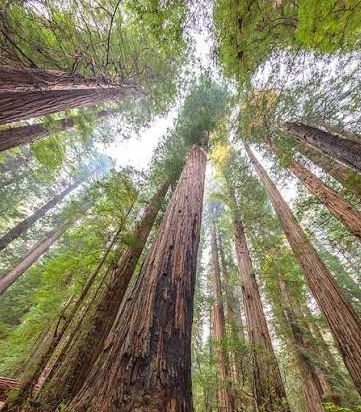
Every tree in a forest carries its own unique signature. Its roots follow a different path. Its branches reach towards the light in their own way. Its bark, leaves and canopy tell the story of a lifetime of adaptation. Examined in isolation, each tree is an extraordinary expression of the divine.
Yet something remarkable happens when we step back.
The individual trees remain important, but our attention shifts to the relationships between them. We begin to see the forest not as a collection of separate trees, but as a living system. Nutrients are shared beneath the ground. Light is negotiated rather than simply consumed. Disease is resisted collectively. The health of one tree becomes inseparable from the health of its neighbours.
This is how consciousness evolves.
Early consciousness is fascinated by form. It studies the individual tree. It measures its height, identifies its species and examines the shape of its leaves. It asks, “What is this?”
As consciousness expands, the inquiry changes. It becomes less interested in the tree itself and more interested in its relationships. It asks how trees communicate, cooperate, compete and sustain one another. The question shifts from “What is it?” to “How does it belong?”
The tree has not changed.
The forest has not changed.
What has changed is the observer.
We begin to perceive patterns that were always present but previously invisible. The forest reveals itself not as thousands of independent organisms, but as a single living ecology expressed through many forms.
This is the essence of the feminine.
The masculine recognises the individual form. The feminine recognises the relationships that give those forms meaning. Neither is complete without the other. One sees the tree. The other sees the forest.
The evolution of consciousness is not the abandonment of one for the other. It is the capacity to hold both simultaneously. To honour the uniqueness of every tree while recognising that no tree exists apart from the forest.
Awakening is not discovering a new forest. It is finally perceiving the one we have always been standing in.
The history of work can be understood through the same lens.
Before industrialisation, the artisan was known through their craft. A cabinetmaker, potter, blacksmith or stonemason left a distinctive signature on everything they produced. Identity and work were inseparable.
Every artisan was, in effect, a unique tree within the forest.
The industrial age transformed the form of work. Standardisation replaced individuality. Scale replaced signature. Efficiency replaced expression. The worker became increasingly interchangeable, valued less for their uniqueness than for their ability to contribute to a larger machine. Identity shifted from “I make” to “I work for.” We stopped seeing trees. We saw timber.
For a time, that model produced extraordinary prosperity. Institutions became the dominant organising force of society. Companies, professions, governments and corporations provided identity, security and belonging. The forest appeared to matter more than the individual trees.
Yet as many of those institutions begin to falter, another movement is emerging. Artificial intelligence is reshaping knowledge work. Careers no longer promise certainty. Traditional hierarchies are giving way to networks and ecosystems. Increasingly, people are asking not simply, “What do I do?” but, “Who am I through my work?” The search for meaning has become as important as the search for employment.
This is the Return of the Artisan.
At first glance, it appears to be an individual journey. People seek authentic work, rediscover craft and pursue careers that bear their own signature rather than someone else’s. They reject anonymity in favour of expression. The individual tree begins to re-emerge.
Yet that is only the first stage.
The deeper return is not simply to individuality. It is to relationship. Just as every tree contributes to the health of the forest, every artisan contributes something unique to the collective. Individual expression and collective wellbeing cease to be opposing forces. They become mutually reinforcing.
This is why the return feels so significant. It is not a retreat from society, nor a rejection of institutions. It is an evolution in how we understand our place within them. The artisan no longer stands apart from the forest. The artisan strengthens it.
The healthiest forests are not those where every tree looks the same. They are those where every tree fully expresses its own nature while remaining connected to every other.
The future of work belongs to forests, not plantations.