
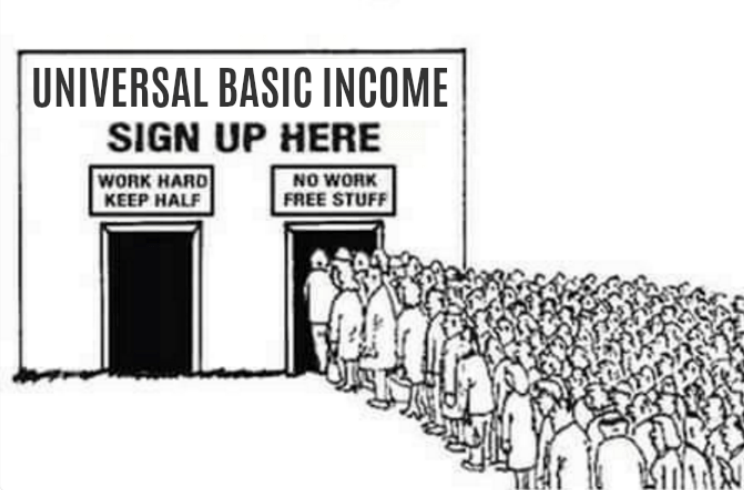
Universal Basic Income (UBI) is suddenly everywhere again.
Entrepreneurs, economists and technologists are openly discussing a future where machines produce most of the world’s goods and services. Andrew Yang argues that UBI may be necessary within three years just to stabilise society. Elon Musk speaks of a world of “universal high income” where productivity explodes and human labour becomes optional.
The debate sounds radical.
But the real shift is far deeper than income support.
Because the question we’re beginning to face is not simply how people will earn money.
It’s what happens to a society when work is no longer its organising principle.
For the past two centuries the industrial system has operated on a simple contract:
Education → Employment → Income → Consumption → Retirement.
This sequence became the backbone of modern life. Work provided income, but it also provided identity, structure and belonging. Ask someone what they do and they will answer with their job title. Occupation became shorthand for social status and personal worth.
The economy was designed around this structure. Businesses produced goods. Workers earned wages. Wages created consumers. Consumers sustained the economy.
But this arrangement only functions when human labour is the primary engine of production.
Artificial intelligence, automation and robotics are beginning to break that assumption.
If machines generate the productivity, the link between labour and income weakens. Companies can produce more with fewer employees. Entire layers of the workforce, particularly entry-level knowledge workers, start to disappear.
This is what technologists mean when they say the ladder is being pulled up.
And it’s why UBI is being discussed again.
Universal Basic Income is essentially an attempt to stabilise the existing system. If machines produce the wealth, the state redistributes some of it so people can continue participating as consumers.
It is, in effect, a patch for the industrial operating system.
But patches don’t usually solve deeper structural shifts.
They buy time.
The deeper transformation begins when abundance decouples survival from employment.
For most of human history survival required work. Food had to be grown, goods had to be made, and labour was necessary to produce them. The industrial revolution mechanised some of that effort, but human labour remained essential.
Automation changes the equation.
If productivity continues to rise while human labour becomes less necessary, economic value begins migrating toward activities that were historically considered secondary.
Creativity. Care. Community. Education. Wellness. Culture.
These have always been central to human life, but they were not treated as the core of the economy because they did not scale the way factories and corporations did.
As machines absorb more production, those previously peripheral activities move toward the centre of human activity.
We are already seeing early signals.
The explosion of creators, independent educators, micro-businesses and digital communities hints at a different economic structure emerging. Careers are beginning to fragment into portfolios of activities rather than single lifelong professions. Individuals move fluidly between roles – consultant, teacher, creator, collaborator.
Small, flexible entities begin to rival large hierarchical organisations.
The gig economy was an early and imperfect version of this shift. But because gig work remained tied to survival income, it often reproduced the pressures of traditional employment.
A post-scarcity environment would look different.
Participation in the economy would become less about securing wages and more about expression, contribution and exchange.
In that world, value is not defined solely by productivity.
It is defined by impact.
Someone who improves community wellbeing, creates art, mentors young people, develops knowledge or strengthens social cohesion is contributing in ways that industrial economics never properly measured.
This is why the current transition feels so volatile.
The industrial worldview taught people that their worth was tied to their job. Remove the job and many experience a loss of identity as much as a loss of income.
When millions of people face that shift simultaneously, instability becomes almost inevitable.
The unrest technologists warn about may not be caused by automation itself.
It may be caused by the collapse of the meaning structures built around work.
That is the real transition we are entering.
UBI may help smooth the economic side of the change. But it does not answer the deeper question that automation forces us to confront.
If human value is no longer measured primarily by employment, then society must redefine what it means to contribute.
In an industrial economy contribution meant producing goods and services efficiently.
In an emerging economy it may mean something else entirely.
Improving human wellbeing. Strengthening communities. Expanding creativity. Advancing knowledge. Cultivating culture.
These forms of contribution are harder to quantify. They do not fit neatly into balance sheets or GDP statistics.
But they may be the domains where human potential becomes most visible once survival is no longer tied to labour.
Seen from that perspective, the debate about Universal Basic Income is not really about welfare policy.
It is about whether society can navigate the transition between two very different organising principles.
The first measured value through productivity.
The second may measure value through human flourishing.
The race between dystopia and utopia may not ultimately be decided by technology.
It may be decided by how quickly we learn to recognise and reward the many ways human beings can contribute to life beyond work.