
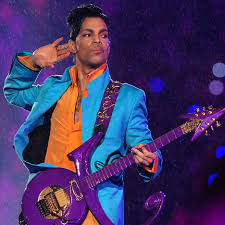
When Prince replaced his name with a glyph, the world laughed, argued, and searched for keyboards that could type it. But what he enacted was more than rebellion against a record label. It was a spiritual move, a conscious migration from form to field, from the masculine world of ownership and language to the feminine realm of resonance and universality.
From Name to Frequency
A name is a container. It defines, limits, locates. Names belong to contracts, to ledgers, to the architecture of patriarchy. They are how systems tag and trade identity. By refusing his, Prince stepped out of the linear alphabet and into vibration. His new mark, half male, half female, shaped like a horn, was not meant to be spoken but felt.
In that gesture he mirrored the feminine principle itself: undefinable, fluid, infinite. He declared, “I am not a product. I am a frequency.” The act was cosmological as much as cultural – a return to the pre-literate world where communication was song, rhythm, gesture, and symbol.
Breaking the Contract
His feud with Warner Bros. was about more than royalties; it was about sovereignty. The corporate world represents the masculine system in its purest form: hierarchy, ownership, measurement. Prince’s resistance was an act of feminine autonomy, reclaiming creation as something that cannot be possessed. By turning himself into an unpronounceable symbol, he created a loophole in language and law. The artist became unsignable. He re-entered mystery.
This is what The Rise of the Feminine names as the shift from control to flow: creation no longer bound by the structures that monetise it. The feminine doesn’t fight the system head-on; it slips between its lines and redefines the field.
Integration of the Poles
Prince embodied polarity with ease, the sacred and the sensual, the preacher and the seducer, lace and leather, falsetto and growl. He didn’t toggle between masculine and feminine; he fused them. The integration itself was his power source. Every performance was a sermon in balance: disciplined musicianship wrapped in ecstatic abandon.
He lived the TROTF principle that true creation emerges when opposites collaborate, light finding its depth in darkness, structure surrendering to spontaneity. In his music, the two energies made love in real time.
Symbol as Universal Language
The glyph united Mars and Venus with sound: ♂ + ♀ + 🎺 = ∞. That synthesis echoed the oldest cosmologies: Yin and Yang intertwined, the masculine and feminine generating life through rhythm. A symbol crosses languages; it belongs to everyone and no one. In adopting it, Prince restored art to universality.
He turned his very identity into a portal: you didn’t read him, you experienced him. That is the feminine mode of knowing, intuitive, relational, participatory. He reminded the world that meaning is not confined to words; it vibrates through sound, colour, and gesture.
Dissolving the Ego Form
To relinquish a name is to dissolve ego. Prince’s transformation was not only defiance but devotion, the same gesture mystics make when they surrender personal identity to merge with the infinite. The masculine says, “I am this.” The feminine whispers, “I am all.”
By disappearing into symbol, Prince became both subject and field, artist and artwork. He turned himself into resonance, which is the feminine state of being: continuous, porous, alive.
The Larger Movement
His evolution anticipated the age of self-definition we now inhabit, gender fluidity, independent publishing, direct creation, artists owning their masters, humans choosing symbols and handles instead of surnames. What looks like digital culture is, at its core, the feminine principle rising again: multiplicity over singularity, flow over form.
Prince did not invent that shift; he personified it. He showed that identity itself could be art, that liberation begins when language no longer owns you.
Light Born of Sound
Caravaggio painted the emergence of light from darkness. Prince composed the sound of form dissolving into frequency. Both revealed the same cosmology: the feminine as the unseen field from which all expression rises and to which all returns.
In every falsetto note, every shimmer of purple silk, Prince enacted the balance this work names, polarity held within universality. He reminded us that the highest act of creation is not assertion but integration.
The Legacy
Prince’s symbol still shimmers between worlds, part glyph, part soundwave, part invocation. It tells us that art, like consciousness, cannot be copyrighted. That the self is not a brand but a vibration. And that the feminine, when it rises, doesn’t destroy structure; it fills it with spirit.
He once said, “I’m not a woman. I’m not a man. I am something that you’ll never understand.” That was not arrogance. It was prophecy, the declaration of a new archetype: the integrated human, the artist as field.
Prince was not merely ahead of his time. He was time in motion – masculine precision and feminine flow dancing in perfect, purple balance.