
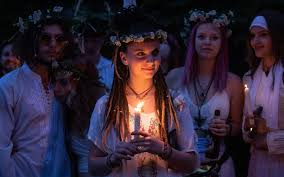
Long before civilisation built temples of stone or hierarchies of doctrine, there was an older, quieter religion. It had no name because it didn’t need one. The people who practised it didn’t think of themselves as “pagan”; they were simply in relationship with the world around them.
To the early agrarian mind, the universe was alive, rhythmic, and cyclical. Life came from the soil, returned to it, and rose again. The divine was not distant; it pulsed through every seed, tide, and birth. Where monotheism later placed God above creation, paganism saw divinity within creation. It was the original feminine field: spacious, generative, relational, forever renewing itself through contrast – day and night, sowing and harvest, birth and decay.
When monotheism arrived, it brought a new structure of knowing. The infinite was given a throne. Mystery became commandment. The feminine principle – fluid, cyclical, intuitive – was recast as chaos, temptation, or heresy. Pagan altars were dismantled, yet the festivals remained. Beltane became May Day; Samhain became All Saints; Yule became Christmas. The feminine field went underground, hiding in custom and folklore. In energetic terms, this was the shift from mythos to logos: from a participatory cosmos to a managed world. The masculine principle of order overtook the feminine principle of flow.
For a thousand years, that field ran beneath civilisation’s surface. It whispered through herbalists, midwives, and storytellers – the so-called witches who tended body and spirit when official religion could only offer confession. Their knowledge of plants, moon cycles, and dreams wasn’t superstition; it was embodied science before the age of abstraction. Every generation tried to burn it out; every generation found it alive again in some other form.
By the eighteenth century, the Enlightenment had replaced miracle with mechanism. Yet the same rational light that exposed superstition also revealed a new void. The world could now be measured but no longer felt. Artists and poets began to sense what was missing: the sacred texture of life itself. The Romantic movement was the first intellectual re-flowering of the pagan feminine – an instinctive correction to the dryness of pure reason.
Today, the field re-emerges under many names: Wicca, Goddess spirituality, eco-feminism, systems thinking, regenerative design. All share the same root principle: life as relationship, not hierarchy. We are no longer outside nature studying it; we are nature becoming conscious of itself. In the pagan worldview, that realisation is initiation – the moment the spiral completes its turn.
Paganism isn’t about reviving old rituals for nostalgia’s sake; it’s about remembering what those rituals encoded: that balance is dynamic, not static; that creation and destruction are partners; that wisdom lives in cycles, not decrees. In the language of energy, the pagan world was the feminine in full expression – the field before the form. What we call “The Rise of the Feminine” is really the return of that field to collective awareness.
The Goddess was never gone. She simply changed her name to Silence and waited for us to listen again.