
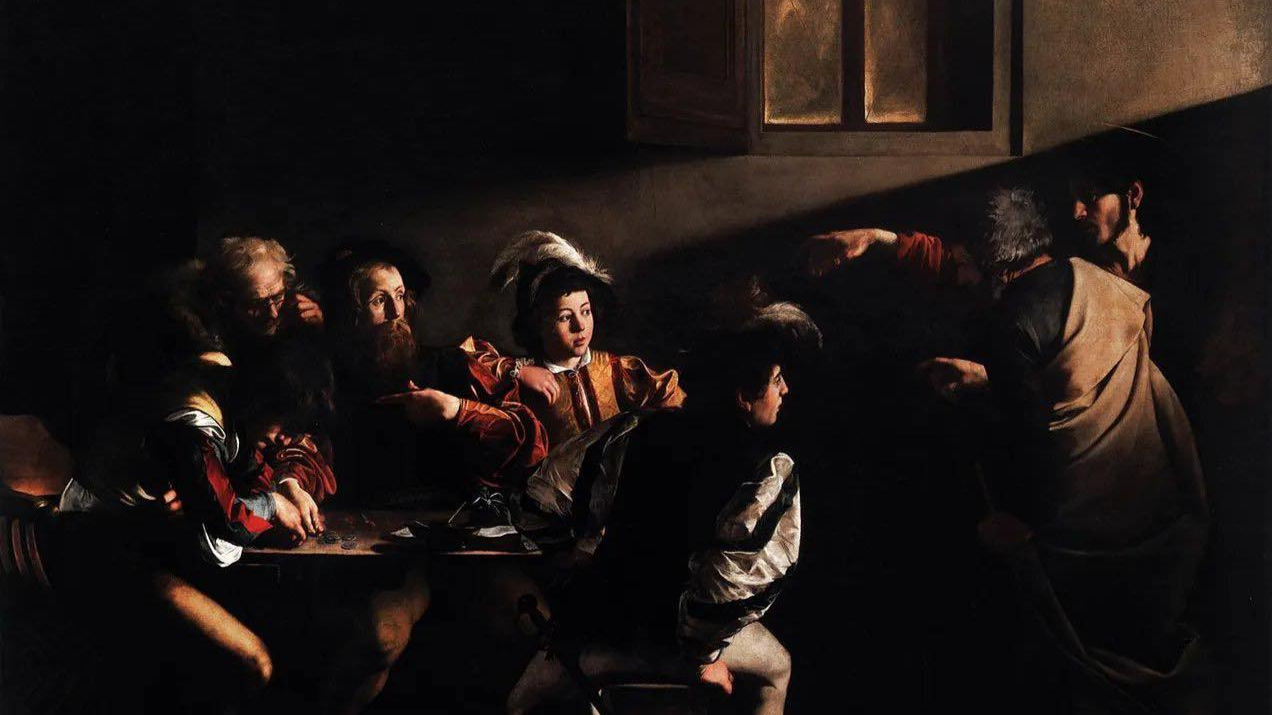
Long before psychology gave us language for shadow and light, Michelangelo Merisi da Caravaggio painted it. His canvases still throb with the tension between revelation and concealment — a visual sermon on polarity itself. Through his brush, we can glimpse the same principle that The Rise of the Feminine explores in words: the field of darkness that births illumination, the union of universality and form.
The Drama of Polarity
Caravaggio’s trademark chiaroscuro is more than technique; it is metaphysics. Light and darkness are not decorative contrasts — they are existential forces.
- Light acts like the masculine: direct, active, declarative.
- Darkness functions as the feminine: receptive, spacious, holding infinite potential.
Every shaft of radiance in his work appears only because there is somewhere deeper for it to emerge from. The black background is not absence but womb. It is the field that allows form to be seen. In this way, Caravaggio doesn’t paint saints and sinners; he paints creation itself — the masculine act arising from the feminine field.
From Idealism to Incarnation
Renaissance art before him polished humanity into marble perfection. Caravaggio broke that spell. He gave holiness back its sweat and dust. Mary looks tired. Peter’s hands are rough. Magdalene’s eyes are swollen from weeping. In bringing divinity down to earth he enacted what the feminine always demands: incarnation, embodiment, reality over ideal.
This descent of the sacred into flesh is the same movement that TROTF identifies as the return of the feminine. It is not ethereal; it is earthy. It invites light to touch matter and matter to mirror light.
The Collision of Forces
His paintings are rarely serene. They vibrate with friction — blades drawn, faces lit mid-gesture, mercy and violence sharing a frame. That turbulence is the cost of imbalance. When the masculine principle of control or conquest dominates, it produces rigidity and blood. When the feminine re-enters, it does not politely replace; it disrupts, softens, dissolves. The meeting of the two generates illumination — literally on the canvas, metaphorically in consciousness.
Caravaggio therefore becomes a portraitist of transition. His light is always new light, just broken from darkness, still raw from its birth.
Darkness as Presence
Look carefully and his darkness moves. It is thick, breathing, alive. The feminine here is not passive shadow but contextual intelligence — the living background that receives and reveals. Without it, light has no dimension. This is the essence of TROTF: the feminine as both polarity and universality, the space that makes every contrast meaningful.
Caravaggio reminds us that illumination is relational. What we call “enlightenment” is simply light remembered against its source.
The Human Mirror
Modern life trains us to seek perpetual brightness — constant productivity, clarity, speed. We fear darkness: rest, uncertainty, stillness. Yet Caravaggio’s compositions whisper the opposite truth. The moment of revelation arrives because of the shadow. Balance is not found in equal halves of brightness but in movement between poles — a rhythm of expansion and return.
The eye moves through his paintings the way consciousness moves through experience: drawn toward brilliance, then invited back into depth. That oscillation is the pulse of life, the dynamic balance that the feminine restores.
Art as Cosmology
In this sense, Caravaggio offers more than aesthetics; he offers a cosmology that pre-dates patriarchy. Before the world was carved into binaries and hierarchies, creation itself followed this law: light emerges from darkness, form from field, the one from the infinite. His canvases re-enact that primal truth. Each figure illuminated in gold is a reminder of the unseen whole that holds it.
He painted at the dawn of modernity, just as Europe was mechanising time, codifying law, industrialising faith. Perhaps unconsciously, he preserved in pigment what society was beginning to forget — the mystery, the womb, the field. In that sense, Caravaggio was an early witness to the Rise of the Feminine, centuries before the phrase existed.
The Lesson for Us
To look at his work today is to remember that shadow is not sin; it is source. The goal is not endless light but living balance. Illumination without depth becomes glare; structure without surrender becomes rigidity. The feminine is rising again not to eclipse the masculine but to restore this dance — to let the darkness breathe so light can truly shine.
Caravaggio’s brush did what language often cannot: it showed that the sacred is born from shadow, that every revelation carries its own darkness, and that the ultimate act of creation is not domination but relationship. That is the timeless message of both his art and the feminine itself — light born of darkness, form arising from the infinite field.