
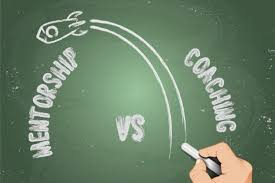
We often use mentoring and coaching interchangeably. Both are about growth, both rely on trust, and both aim to bring out the best in people.
But they run on different operating systems. One is built on experience. The other is built on awareness.
And understanding the difference determines whether you give someone direction — or help them discover it.
Mentoring: Guidance by Precedent
Mentoring begins with experience. It assumes that someone who has walked the path before can shorten the distance for someone following behind.
A mentor reasons deductively — from the general to the specific. They hold principles, lessons, and war stories that they apply to a current situation. They say, “When this happened to me, here’s what worked.”
It’s a download of wisdom. Efficient, direct, reassuring.
Mentors provide clarity through certainty. They stabilise the learner when the stakes are high, or when a decision has obvious precedent.
Think of a mentor as a professional adviser with empathy — someone who offers a frame of reference, a reality check, and the occasional shortcut.
Coaching: Awareness Through Inquiry
Coaching works in the opposite direction. It begins not with what’s been lived, but with what’s being felt right now.
A coach reasons inductively — from the specific to the general. They start with the client’s lived experience and move outward toward meaning.
Where a mentor downloads, a coach draws out. They don’t say, “Here’s what to do.” They ask, “What do you notice?” or “What might that be showing you?”
Coaching is self-directed learning — a conversation that awakens insight rather than transmits knowledge. The coach’s role is not to lead but to hold space for discovery, reflection, and alignment.
It’s not about performance management; it’s about pattern recognition. The client learns to see themselves more clearly and to act from that awareness.
The Difference in Logic
The two disciplines use different kinds of reasoning:

Both are valid — but they serve different moments in the developmental arc.
The Role of Ego
Mentoring carries a healthy dose of ego — not arrogance, but confidence. It’s built on I’ve done this before — the authority of experience. Without that, the advice lacks weight.
Coaching requires the opposite. The ego steps aside so curiosity can take the lead. The coach doesn’t need to know the answer; they need to trust the process.
One draws on the authority of experience, the other on the discipline of awareness. That’s why coaching often feels lighter, but deeper. It’s less about “right and wrong” and more about “seen and unseen.”
The Flow of Energy
You can think of mentoring and coaching as two ends of a current.
- Mentoring provides structure, direction, and focus. It’s the closing motion — it narrows options and moves toward decision.
- Coaching provides space, curiosity, and reflection. It’s the opening motion — it expands awareness and surfaces possibility.
Neither is superior; both are essential. Growth requires expansion and consolidation, discovery and direction.
When to Use Which
Use mentoring when:
- The challenge has precedent.
- The learner lacks context.
- Time or risk doesn’t allow for experimentation.
- The need is confidence through guidance.
Use coaching when:
- The situation is new or ambiguous.
- The learner needs ownership, not instruction.
- Insight matters more than speed.
- The goal is awareness and sustainable change.
In simple terms:
Mentors help you decide. Coaches help you discover.
The Practitioner’s Challenge
Most people drift unconsciously between the two — giving advice when curiosity was called for, or asking questions when direction was needed.
Mastery lies in knowing which mode serves the moment.
A skilled practitioner opens with curiosity, then closes with clarity. They start inductively — exploring the experience — and finish deductively — naming the insight. It’s a dance between space and structure.
Too much mentoring and the learner becomes dependent. Too much coaching and they become untethered. Balance creates momentum.
The Larger Implication
This distinction matters well beyond personal development. It underpins how leaders build teams, how directors run boards, how managers conduct reviews.
The question is not which is better, but which is required now. Does this moment call for certainty or curiosity? Does it need answers or awareness?
Knowing the difference is the mark of mature leadership.
Closing Thought
Mentors pass on what they know. Coaches awaken what others already know.
One draws lines on a map; the other hands you the compass.
Different physics. Same destination — growth.