
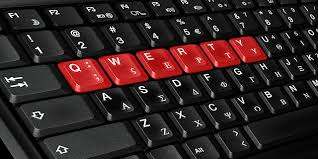
How your thumbs became hostage to a 150-year-old machine
“The keyboard you use was designed to slow you down. And you still use it—even when your thumbs are faster than your brain.”
Let’s talk about QWERTY. Not because it’s sexy. But because it’s symbolic.
It’s the kind of dusty holdover from history we never question. Like neckties. Or shareholder primacy. Or the idea that productivity is a virtue.
We didn’t choose it. We inherited it.
And now, we tap away on glass screens with our opposable thumbs, shackled to a layout designed for metal arms.
🧓 The Story: A Keyboard Designed for Slowness
Back in the 1870s, a Milwaukee newspaper editor named Christopher Latham Sholes built the first commercial typewriter. It had long metal typebars that jammed easily when fast typists hit neighboring keys in quick succession.
So he and his collaborators designed a layout that would:
🛑 Slow people down
⚙️ Spread out common letters
⛔️ Reduce mechanical collisions
Enter: Q-W-E-R-T-Y.
A workaround. A hack. A mechanical compromise.
And then? Remington mass-produced it, taught the layout to early typists (mostly women), and boom—it became the global standard.
🤳 Fast Forward to 2025:
You’re not typing on a Remington No. 1. You’re typing on a handheld supercomputer with your thumbs.
You’re sending emails from bed. You’re texting while walking. You’re thumbing LinkedIn posts at traffic lights. (No comment.)
But somehow… You’re still tied to a layout designed to solve a problem that hasn’t existed in 100 years.
That’s not convenience. That’s inherited inefficiency.
💥 QWERTY as Metaphor: What Else Are You Doing That No Longer Serves You?
This isn’t really about keyboards. It’s about systems that outlived their usefulness but still dominate.
It’s about:
- Organisations still designed like pyramids
- Leadership still measured by decisiveness, not depth
- Workdays still shaped by factory whistles
- Language still coded in conquest and competition
QWERTY isn’t just your keyboard. It’s your boardroom. It’s your playbook. It’s your stress. It’s your default setting.
🧠 Why We Keep Using It
Because it’s familiar. Because it’s embedded. Because it’s easier to keep using the old design than to think about why it exists.
Just like so many other things:
- Hustle culture
- “Work hard, play hard” slogans
- Masculine-only models of leadership
- Constant availability as proof of commitment
We’re not optimising for flow. We’re just typing faster on a broken system.
🌀 The Feminine Reframe
If you know my work, you’ll know this isn’t about keyboards—it’s about context.
QWERTY is a relic of masculine energy: designed to control a system, prevent overload, maintain order. And at the time? It worked.
But we’ve evolved.
We now operate in a world of:
- Gesture control
- Voice-to-text
- Neural typing (hello, brain-computer interface)
- Emotional resonance, not just mechanical speed
The tools have changed. The context has changed. But the defaults haven’t.
That’s why balance matters. That’s why language matters. That’s why The Rise of the Feminine matters.
Because contextual intelligence is the new speed.
Final Reflection
You’re not slow because you’re out of touch. You’re slow because the system was built to slow you down.
And yet— you kept going. You adapted. You thumb-typed your way into the future.
Now it’s time to do the same with leadership, business, and self.
QWERTY isn’t broken. It’s just outdated.
🎯 Want to unlearn the systems that no longer serve?
Take the test: Are You Leading from Balance or Burnout?